
Sensex today ended marginally lower on May 21, 2026, as oil price concerns, geopolitical uncertainty, and cautious investor sentiment triggered volatility across Indian markets.
The trading session remained volatile throughout the day as geopolitical uncertainty, oil market pressure, and cautious investor positioning weighed on broader sentiment.
The BSE Sensex closed over 130 points lower while the Nifty50 struggled to maintain momentum despite intermittent recoveries throughout the trading day. Market participants closely monitored developments surrounding escalating tensions involving Iran and the United States, which triggered renewed concerns over crude oil prices and broader global market stability.
According to reports published by The Economic Times, investors remained cautious through the session as mixed global cues and futures expiry volatility added pressure on equities.
Despite the weak close, analysts observed that Indian markets continued to show relative resilience compared to several global peers, suggesting domestic institutional participation remained active underneath the surface.
Global Tension And Oil Prices Trigger Market Anxiety
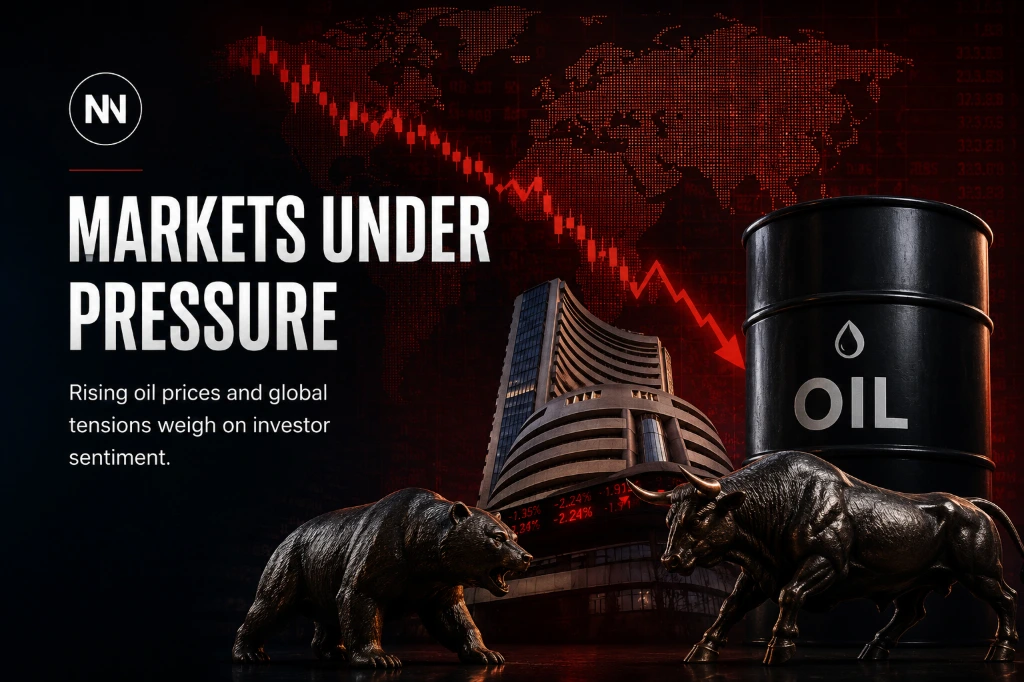
Much of the nervousness in the market emerged from rising geopolitical tension connected to the Iran-US situation, which immediately influenced global oil market sentiment.
Higher crude oil prices typically create inflationary pressure for import-heavy economies such as India. Rising oil costs can impact transportation, manufacturing, aviation, logistics, and consumer spending, making investors increasingly cautious during periods of geopolitical instability.
A live market analysis published by NDTV Profit highlighted that concerns surrounding oil volatility and global risk sentiment contributed significantly to intraday market swings.
The market reaction reflected a broader global pattern where investors shifted toward defensive positioning amid uncertainty.
Safe-haven assets such as gold witnessed renewed attention internationally while risk-sensitive sectors experienced fluctuations during the Indian trading session.
Although no major panic selling emerged, traders clearly avoided aggressive risk exposure.
Volatility Dominated Trading Throughout The Day
The session witnessed sharp intraday swings as traders navigated multiple overlapping factors simultaneously:
- Global geopolitical uncertainty
- F&O expiry pressure
- Oil price volatility
- Mixed Asian market cues
- Sector-specific profit booking
- Institutional portfolio adjustments
At several points during the session, markets attempted recoveries before renewed selling pressure pushed indices back into negative territory.
According to coverage from The Times of India, market participants remained especially cautious around banking, IT, and energy-linked counters while traders monitored international developments closely.
The volatility also reflected uncertainty over the near-term direction of foreign institutional investment flows.
Foreign investors often reduce exposure temporarily during periods of geopolitical instability, particularly when oil prices begin moving sharply higher.
That possibility contributed to the cautious mood visible across Dalal Street.
Defensive Sectors Showed Relative Stability

While broader sentiment remained fragile, several defensive segments showed relative resilience during the session.
Consumption-focused businesses, select FMCG stocks, and certain pharmaceutical counters managed to attract investor interest as traders searched for stability amid uncertainty.
Meanwhile, sectors directly sensitive to fuel prices and global trade conditions faced additional pressure.
Market participants also observed selective rotation into fundamentally stronger large-cap stocks, suggesting investors were becoming more selective rather than exiting equities entirely.
A market report from The Hindu described the session as volatile but controlled, with indices ultimately ending only marginally lower despite repeated intraday swings.
That distinction matters.
The absence of panic-driven collapse indicates investors still believe India’s broader economic fundamentals remain comparatively stable even during periods of external uncertainty.
Why Oil Prices Matter So Much For Indian Markets
Crude oil remains one of the most influential external variables for the Indian economy.
India imports a large percentage of its energy requirements, meaning sharp increases in oil prices can quickly affect inflation, currency stability, transportation costs, manufacturing margins, and consumer spending patterns.
When geopolitical conflict threatens global energy supply chains, financial markets react almost immediately.
Higher oil prices can:
- Increase inflationary pressure
- Affect RBI policy expectations
- Reduce corporate profitability
- Impact consumer demand
- Increase fiscal pressure
- Weaken import economics
That is why geopolitical headlines linked to the Middle East often trigger strong reactions across emerging markets, especially India.
Investors are not merely reacting to headlines themselves.
They are reacting to what those headlines could eventually mean for inflation, interest rates, and economic growth.
F&O Expiry Added Additional Pressure
Another major contributor to market volatility was the monthly Futures & Options expiry session.
F&O expiry days often witness rapid price movements because traders unwind, roll over, or rebalance leveraged positions before contracts expire.
That mechanical pressure can exaggerate intraday market swings even when broader fundamentals remain unchanged.
Combined with geopolitical uncertainty and global nervousness, expiry-related trading activity amplified volatility across several heavyweight counters.
Short-term traders remained active throughout the day while long-term investors appeared comparatively cautious.
Analysts noted that volatility levels may remain elevated over the next few sessions depending on how global developments evolve.
Investors Are Watching Global Signals Carefully
Beyond domestic factors, Indian investors are currently monitoring several major international developments simultaneously:
- US Federal Reserve commentary
- Global inflation trajectory
- Oil market movement
- China demand signals
- Middle East geopolitical developments
- Foreign institutional investor activity
Markets today operate in an extremely interconnected environment.
A geopolitical event thousands of kilometers away can rapidly affect investor psychology, commodity pricing, currency movement, and equity valuations across emerging economies.
That interconnectedness was visible throughout the trading session.
Although Indian markets avoided heavy damage, the mood clearly reflected caution rather than confidence.
Indian Markets Still Show Relative Strength
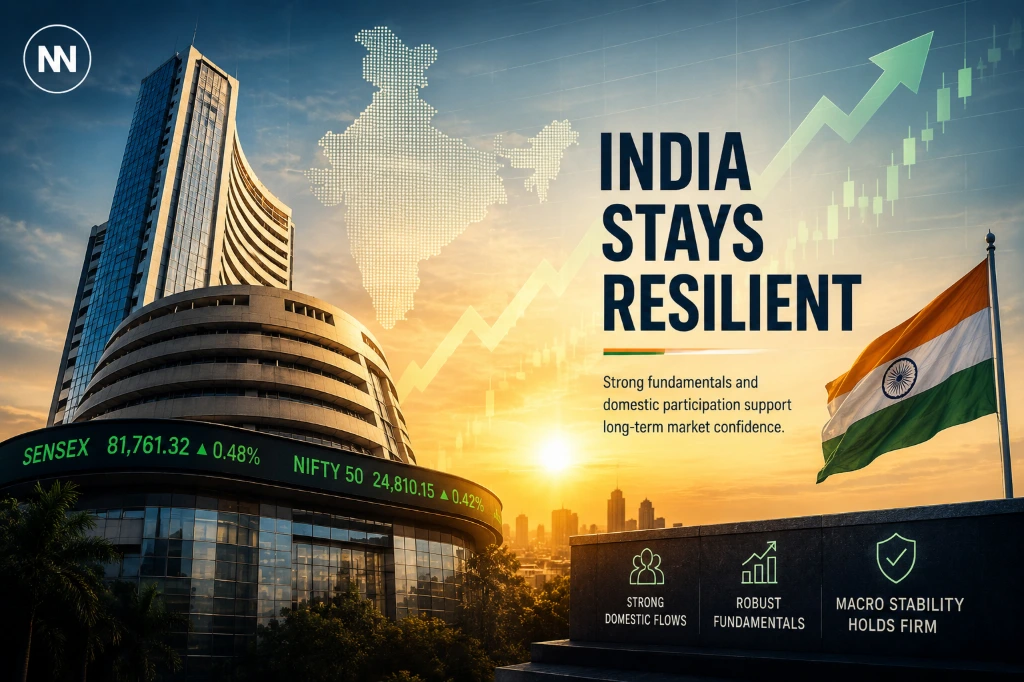
Despite the weaker close, many analysts believe Indian equities continue to demonstrate relative structural strength compared to several other emerging markets.
Domestic SIP inflows, retail investor participation, infrastructure spending, and long-term economic growth expectations continue supporting broader market sentiment underneath short-term volatility.
Even during uncertain sessions, strong buying interest frequently emerges near key support levels.
That pattern suggests investors continue viewing market corrections as temporary rather than structural breakdowns.
The broader long-term India growth narrative remains intact for now.
However, short-term volatility is likely to remain elevated if geopolitical risks continue escalating globally.
Why This Session Matters Beyond One Trading Day
This trading session represented more than just another negative close for Sensex and Nifty.
It revealed how deeply interconnected modern financial markets have become.
A combination of geopolitical anxiety, oil market pressure, derivatives expiry, and global investor caution shaped sentiment simultaneously within a single trading day.
For ordinary investors, the session also served as a reminder that markets do not move only on company earnings or domestic politics anymore.
Global events increasingly influence local financial behavior in real time.
That reality makes risk management, diversification, and disciplined investing more important than ever.
While long-term investors may continue focusing on India’s structural growth story, short-term traders are likely to remain highly sensitive to global headlines over the coming weeks.
For now, Dalal Street appears cautious — but not panicked.
And in volatile markets, that distinction matters enormously.