
For decades, London's property market was viewed as one of the world's most reliable wealth-building engines. Rising house prices, strong international demand, and a reputation as a global financial capital helped fuel a long period of property appreciation that attracted homeowners, investors, and overseas buyers alike.
Yet the London housing market of 2026 looks very different from the one many people became accustomed to over the previous decade.
While the wider UK property market continues to show pockets of resilience, London has increasingly become an outlier. Property prices in the capital have struggled to match growth seen in several northern regions of England, while affordability challenges, elevated borrowing costs, and changing buyer behaviour have slowed momentum across many parts of the city.
At the same time, another industry is quietly benefiting from this shift.
Interior design, renovation, and home improvement businesses are experiencing strong demand as more homeowners choose to improve their existing properties rather than relocate.
The result is a fascinating transformation in the way Londoners think about housing, investment, and lifestyle.
A Housing Market Under Pressure

London remains the most expensive major housing market in the United Kingdom. For many buyers, particularly first-time purchasers, affordability has become a significant barrier.
Higher mortgage rates over the past several years have fundamentally altered purchasing power. Even relatively modest increases in borrowing costs can add hundreds of pounds to monthly mortgage repayments, making larger homes or premium locations increasingly difficult to justify.
Property analysts have observed a widening gap between London and several regional markets across the UK.
According to the UK House Price Index published by HM Land Registry and the Office for National Statistics (ONS), London has recently underperformed several northern and midland regions, reflecting affordability pressures, higher transaction costs and changing buyer behaviour.
Zoopla's latest House Price Index suggests that buyers have become significantly more selective than they were during the low-interest-rate era, as affordability pressures and higher borrowing costs continue to influence purchasing decisions. Homes often remain on the market longer, negotiations have become tougher, and sellers are increasingly required to price realistically to secure transactions.
For many households, moving has become a significantly more expensive decision than it once was.
The Rise of the “Improve, Not Move” Economy
As moving becomes more costly, homeowners are increasingly asking a different question:
Why move at all?
Rather than spending money on stamp duty, legal fees, moving expenses, and higher mortgage repayments, many homeowners are choosing to invest directly into the homes they already own.
This behavioural shift has become one of the most important trends shaping the UK housing sector.
Recent renovation studies indicate that more than a quarter of homeowners are now more likely to renovate than relocate, while younger generations show an even stronger preference for upgrading existing properties instead of entering an expensive moving process.
The logic is simple.
A homeowner who already enjoys a favourable mortgage rate and a familiar neighbourhood may find it far more economical to build an extension, redesign a kitchen, create a home office, or modernise an outdated property than to purchase an entirely new home.
For many London households, the home itself has become the investment vehicle.
Renovation Spending Continues To Climb
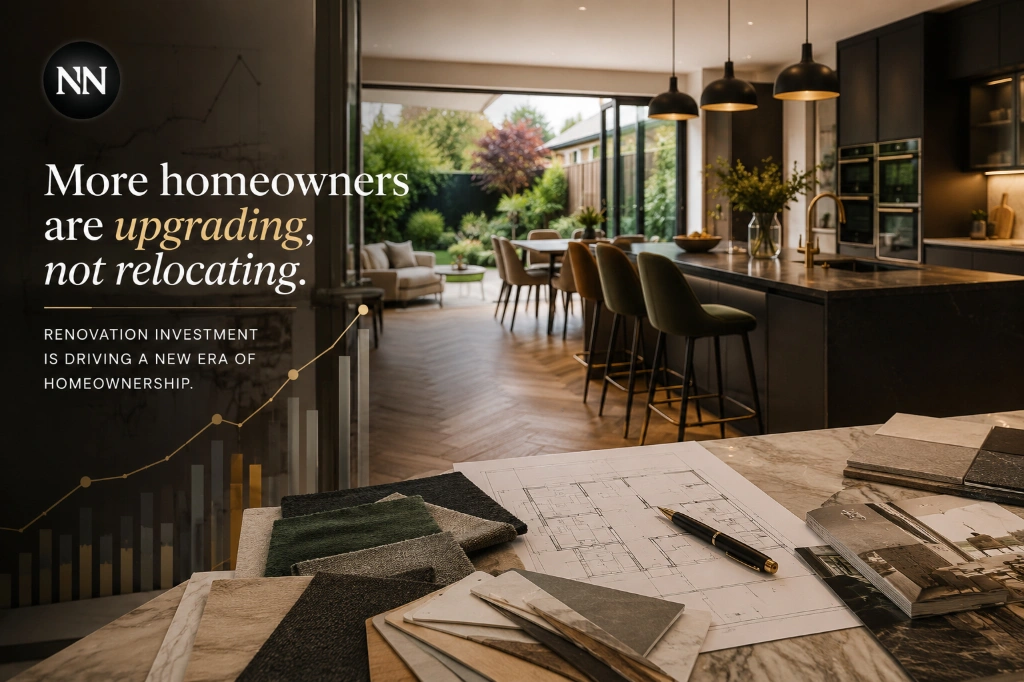
The numbers behind the renovation market reveal just how significant this trend has become.
The 2025 UK Houzz & Home Renovation Trends Study found that more than half of homeowners undertook renovation projects during the previous year, while median renovation spending exceeded £21,000. The study highlights a broader shift toward larger, more ambitious renovation projects compared with previous years.
At the premium end of the market, spending levels are considerably higher.
Many affluent homeowners are committing six-figure budgets to complete property transformations, while some luxury projects extend well into seven-figure territory.
What makes this trend particularly significant is that renovation spending is no longer limited to cosmetic improvements.
Homeowners are investing in:
- Complete kitchen redesigns
- Luxury bathroom upgrades
- Home office construction
- Smart home technology
- Energy-efficiency improvements
- Extensions and loft conversions
- Wellness and entertainment spaces
In many cases, these improvements are designed to support a decade or more of future occupancy rather than a quick resale strategy.
That long-term mindset is reshaping the entire residential design sector.
The Modern Home Has Changed
The pandemic accelerated a trend that continues to influence housing decisions years later.
The modern home is expected to serve multiple functions simultaneously.
It is a workplace.
It is an entertainment space.
It is a wellness retreat.
It is often a long-term family asset.
As a result, homeowners are placing greater emphasis on functionality, flexibility, and comfort.
Dedicated home offices remain popular among professionals working hybrid schedules. Open-plan living spaces continue to evolve, while kitchens have become social hubs rather than purely practical cooking areas.
Bathrooms are increasingly designed to resemble private wellness retreats, featuring premium materials, spa-inspired layouts, and luxury finishes.
The objective is no longer simply to own a home.
The objective is to create a home that genuinely enhances quality of life.
Why Interior Designers Are Benefiting
This changing mindset has created significant opportunities for professional designers.
The UK's interior design industry continues to grow steadily, supported by rising renovation activity and growing consumer expectations.
Today's homeowners are increasingly willing to hire professionals rather than rely on do-it-yourself solutions.
Design projects have become more technically demanding, often involving structural alterations, bespoke joinery, integrated lighting systems, sustainability upgrades, and advanced smart-home technology.
Professional guidance is no longer viewed as a luxury reserved for the ultra-wealthy.
Instead, it is increasingly seen as a practical investment that helps homeowners maximise both lifestyle value and property value.
The demand is especially strong in London, where renovation budgets tend to be larger and property owners often seek highly customised solutions.
London's Luxury Design Leaders

At the premium end of the market, London remains one of the world's most influential design capitals, home to studios that continue to shape the aesthetics of luxury living across the UK and beyond.
Kelly Hoppen Interiors has built an international reputation over nearly five decades, becoming synonymous with timeless elegance, neutral palettes and its signature East-meets-West design philosophy.
Founded in 2014, Studio Ashby has emerged as one of Britain's most distinctive contemporary design practices, known for its art-led interiors that combine creativity, craftsmanship and individuality.
Established in 1985, David Collins Studio remains a leading force in luxury hospitality, retail and residential design, with landmark projects including The Wolseley, The Connaught Bar and prestigious developments across five continents.
Founded in 2010, 1508 London has grown into a globally recognised luxury design and architecture firm, specialising in ultra-prime residences, hospitality projects, luxury developments and superyachts.
Katharine Pooley is internationally respected for creating highly personalised luxury interiors, combining exceptional craftsmanship with meticulous attention to detail across residences, hotels, villas, yachts and private estates worldwide.
Meanwhile, Helen Green Design is known for sophisticated British interiors that blend timeless elegance with contemporary comfort, creating homes that are both refined and deeply personal.
Alongside these established names, independent studios are also helping shape the future of British interior design. Yorkshire-based House of Ahana specialises in bespoke, design-led interiors that balance quiet luxury with functionality, reflecting a growing demand for personalised living spaces beyond London's traditional luxury market.
Together, these firms highlight how homeowners are increasingly investing in design quality, craftsmanship and long-term lifestyle improvements—an evolution that continues to drive demand across the UK's interior design industry.
Sustainability Is Driving The Next Wave
Another factor supporting renovation demand is sustainability.
Energy efficiency has become both an environmental and financial consideration.
Homeowners now recognise that investments in insulation, glazing, heating systems, solar technologies, and energy-efficient appliances can generate long-term savings while improving comfort.
Government policies encouraging energy upgrades have further strengthened this trend.
Landlords, in particular, face growing pressure to improve energy performance standards across rental properties, creating an additional source of renovation demand that is largely independent of wider property market conditions.
This means renovation activity is no longer driven solely by aesthetics.
It is increasingly linked to regulation, efficiency, and future-proofing.
What This Means For Property Owners
The relationship between property and design is changing.
Historically, homeowners often relied on market appreciation to increase wealth.
Today, many are actively creating value themselves.
A thoughtfully designed kitchen can improve daily living.
A well-executed extension can unlock additional usable space.
A carefully planned renovation can improve energy performance, functionality, and resale appeal.
In a slower housing market, these improvements often become more important than waiting for prices to rise.
Rather than treating their homes as temporary assets, homeowners are treating them as long-term investments deserving ongoing improvement.
Looking Ahead

Knight Frank's UK Housing Market Forecast suggests that London's property market is unlikely to return overnight to the rapid growth environment that defined much of the previous decade, with analysts expecting a more measured period of growth in the years ahead.
Affordability constraints, borrowing costs, and evolving buyer expectations suggest that a more measured market may become the new normal.
Yet slower property growth does not necessarily mean reduced investment in housing.
The evidence increasingly points in the opposite direction.
As homeowners choose to stay put, they are committing more resources than ever to improving the spaces they already occupy.
The result is a powerful shift in capital allocation—from buying new homes to improving existing ones.
For interior designers, architects, builders, and renovation specialists, this represents a significant long-term opportunity.
And for homeowners, it reflects a broader realisation that may define the next chapter of London's housing story:
When moving becomes expensive, improving becomes the smarter investment.