
Diplomatic meetings are usually predictable.
Leaders shake hands. Delegations exchange formal statements. Agreements are announced. Cameras flash for a few seconds before the world moves on to the next headline.
But some meetings generate attention beyond politics.
The latest interaction between Narendra Modi and Giorgia Meloni in Rome felt different almost immediately.
- Part of that attention came from optics.
- Part came from timing.
- And part came from the internet itself.
Over the past year, the Modi–Meloni dynamic has quietly evolved into one of the most recognizable pieces of modern political imagery online — a mix of diplomacy, visual chemistry, strategic cooperation, and social media fascination that many users jokingly describe as “Melodi diplomacy.”
But behind the memes and viral moments, something more serious is also happening:
- India and Italy are visibly moving closer strategically.
- And Rome made that increasingly difficult to ignore.
This Was About More Than Symbolism
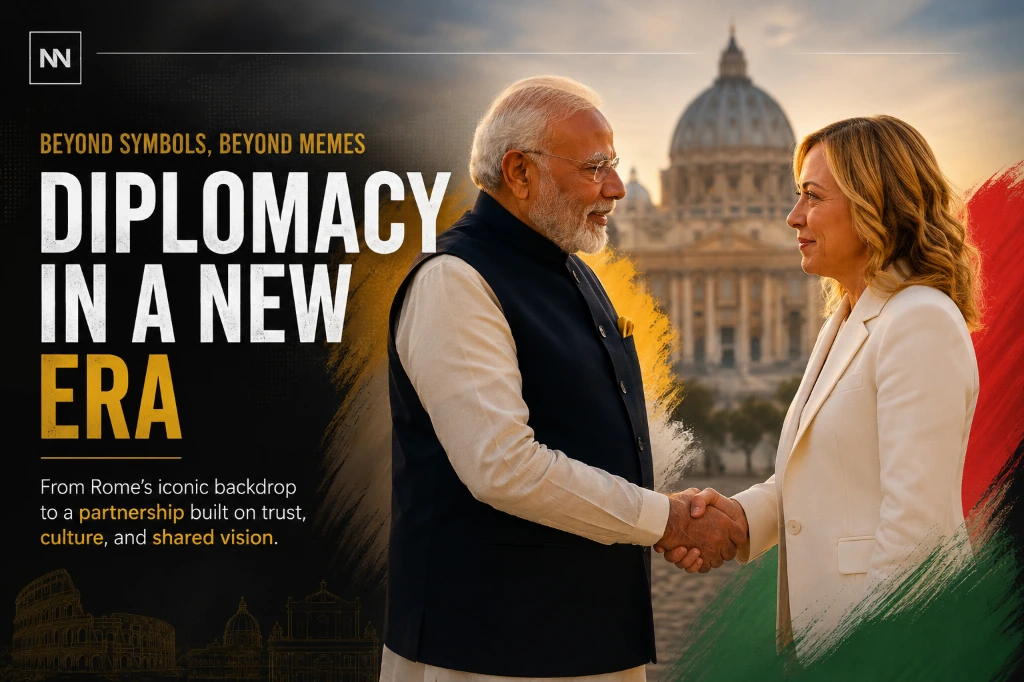
Officially, the meeting focused on expanding cooperation between India and Italy across trade, defence, technology, and global partnerships.
According to The Telegraph India, both leaders described India–Italy relations as entering a “decisive stage,” with stronger emphasis on strategic coordination and economic collaboration.
That wording matters.
Diplomatic language is often carefully measured, and phrases like “decisive stage” are rarely used casually. It signals that both governments increasingly see each other as long-term partners rather than occasional collaborators.
For India, strengthening ties with European powers has become an important part of its broader global positioning strategy.
For Italy, India represents both a massive economic opportunity and a rising geopolitical force whose influence continues to expand across trade, technology, manufacturing, and international diplomacy.
But what made this meeting stand out was not just the policy discussion.
It was the presentation of the relationship itself.
The Internet Has Changed Political Optics Forever
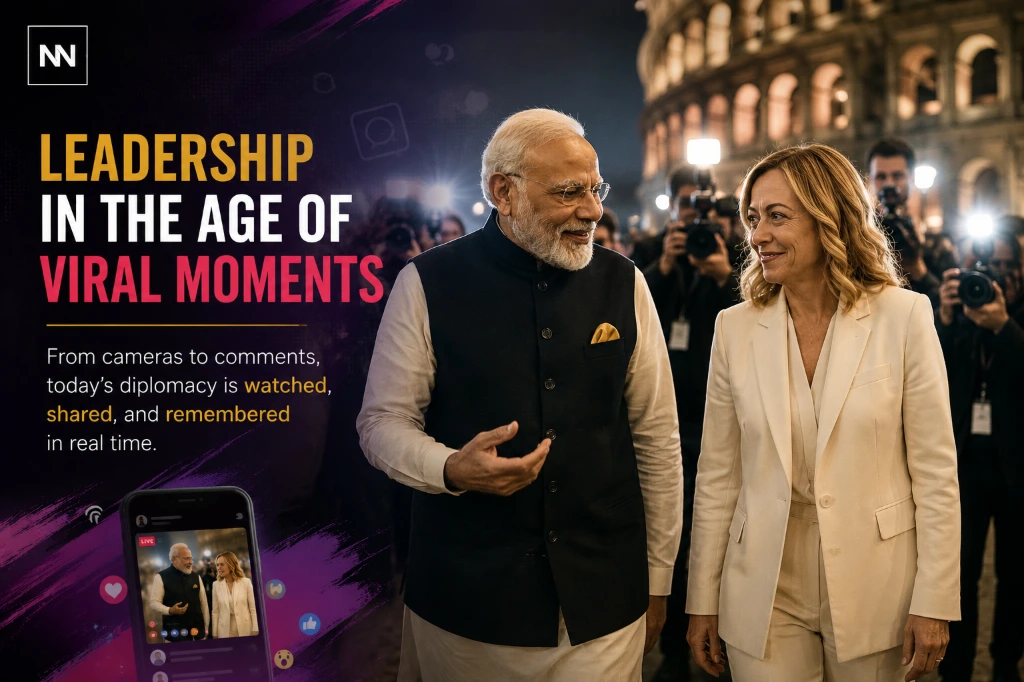
Modern diplomacy no longer exists only inside conference rooms.
It now unfolds publicly — in photographs, short videos, carefully framed gestures, viral clips, and instantly shareable moments that circulate across social media within seconds.
And very few political pairings have unintentionally generated as much online fascination recently as Modi and Meloni.
That internet-driven attention resurfaced again during the Rome meeting.
According to The Times of India, Prime Minister Modi presented Meloni with a thoughtful gift that quickly became part of the wider online conversation surrounding the meeting.
The internet immediately did what it always does:
it transformed a diplomatic moment into a cultural moment.
And while many governments still underestimate the importance of these optics, modern political influence increasingly depends on exactly this kind of visibility.
People may not remember the wording of joint statements.
- But they remember images.
- They remember chemistry.
- They remember moments that feel human.
That matters more now than many traditional political analysts are willing to admit.
Rome Also Revealed India’s Soft-Power Confidence
One of the most visually interesting moments from the visit had little to do with policy itself.
According to NDTV, Modi also interacted with Italian painter Giampaolo Tomassetti, whose artwork reportedly reflected imagery connected to Kashi.
At first glance, it may seem like a small cultural interaction.
But symbolically, it reflects something larger:
India increasingly projects its civilizational identity alongside its geopolitical ambitions.
That combination has become central to modern Indian diplomacy.
The message is subtle but consistent:
India does not only want to be seen as a market or strategic ally.
It also wants to be seen as a cultural power with historical depth and global influence.
And that approach appears increasingly deliberate under Modi’s international outreach strategy.
In Rome, those cultural signals blended naturally with political imagery.
- Ancient European architecture.
- Indian symbolism.
- Global leadership.
- Social media attention.
All of it created visuals that felt carefully modern without appearing overly staged.
That balance is politically valuable.
Why These Optics Actually Matter
Critics often dismiss political optics as superficial.
But history repeatedly shows that public perception shapes international relationships more than governments openly admit.
Strong optics create familiarity.
Familiarity creates trust.
And trust often creates political flexibility.
The Modi–Meloni interactions now carry a level of public visibility that most bilateral diplomatic relationships never achieve.
That visibility has advantages.
For India, it strengthens the image of a country that is increasingly central to global conversations.
For Italy, it reinforces the image of an influential European government building meaningful partnerships outside traditional Western power circles.
And importantly, these interactions feel less rigid than traditional diplomatic performances.
- They appear modern.
- Informal at times.
- Social-media aware.
- Visually approachable.
That matters in an era where global leaders are increasingly judged not only by policy — but also by communication style and public relatability.
India’s Global Positioning Is Becoming More Confident
Beyond the optics themselves, the Rome meeting also reflects a broader shift in India’s international posture.
India today engages with global powers differently than it did even a decade ago.
The country now projects confidence more openly across:
- trade negotiations,
- strategic partnerships,
- defence cooperation,
- technology discussions,
- and diplomatic visibility.
Rather than staying confined to one geopolitical bloc, India increasingly positions itself as a country capable of building relationships across multiple power centers simultaneously.
That flexibility has become one of India’s biggest diplomatic strengths.
And Europe is paying attention.
Italy, in particular, appears increasingly interested in expanding cooperation with India across manufacturing, defence production, energy transition, and technological collaboration.
According to The Hindu, the Rome discussions formed part of a larger diplomatic outreach effort connected to India’s broader international engagements.
This is no longer just symbolic diplomacy.
Economic and strategic interests are clearly becoming deeper.
The Real Story Is How Diplomacy Is Evolving
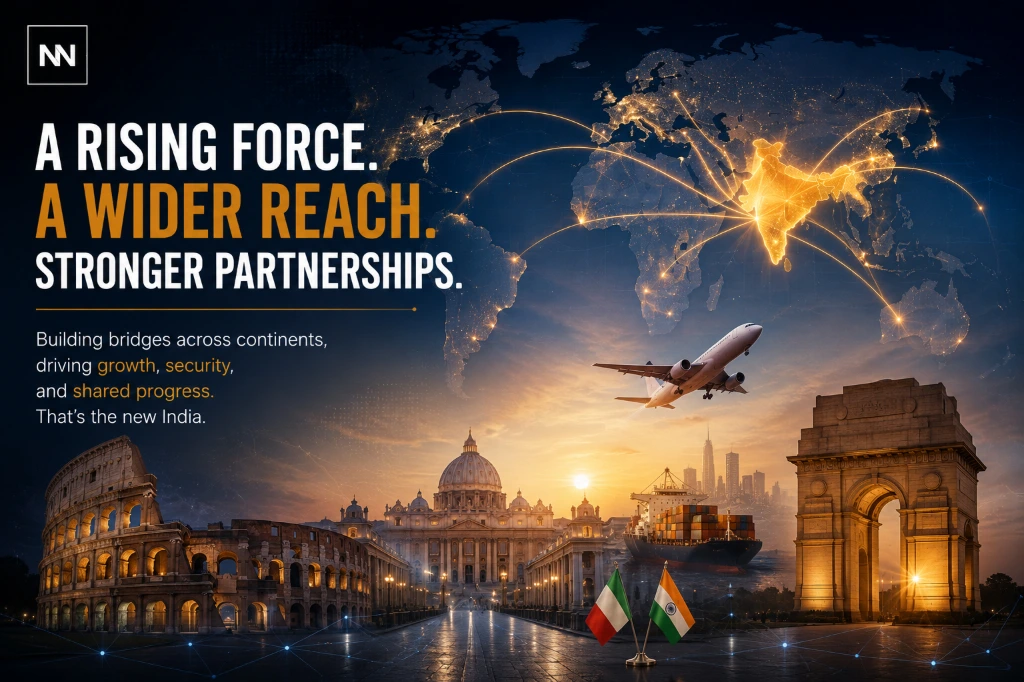
Perhaps the most interesting part of the Modi–Meloni meeting is not the leaders themselves.
It is what their visibility says about modern politics.
Diplomacy today is no longer hidden behind closed doors.
It is performative, visual, emotional, and constantly online.
Governments now communicate simultaneously with:
- foreign leaders,
- domestic audiences,
- global investors,
- media networks,
- and internet culture itself.
That changes how diplomacy works.
A single photograph can shape narratives faster than a formal press conference.
A short interaction can become a global meme within minutes.
And public perception increasingly influences political influence.
The Rome meeting captured all of that at once.
Yes, there were discussions about trade and cooperation.
But there was also something else:
an understanding that visibility itself has become part of modern power.
And that may ultimately be the real reason why the Modi–Meloni optics matter.