
Research & Analysis by Tanya Narayan
Artificial intelligence is often discussed in terms of capability. Headlines focus on increasingly powerful models, breakthrough applications, and the race between technology giants to build systems that are faster, smarter, and more autonomous than ever before.
Yet beneath the excitement surrounding AI lies a quieter and potentially more consequential contest. The real question is no longer simply what artificial intelligence can do. It is who will decide the rules under which it operates.
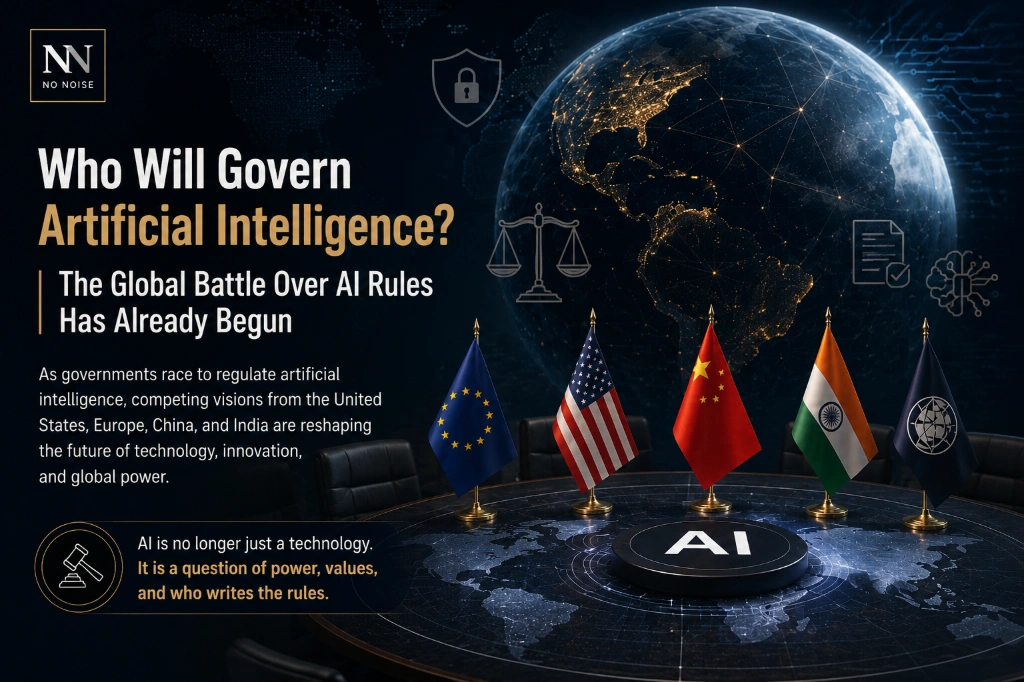
As governments scramble to regulate a technology evolving faster than traditional policymaking can keep pace with, the world is moving toward a fragmented system of AI governance. Rather than converging around a single international framework, major powers are developing competing regulatory models shaped by their own political values, economic priorities, and national security concerns.
The result is the emergence of a new form of digital geopolitics—one in which regulation itself has become a strategic tool.
From Innovation Race to Governance Race
Artificial intelligence now influences everything from hiring decisions and financial services to healthcare diagnostics, logistics networks, education platforms, and public communication.
Unlike many previous technologies, AI has reached mainstream adoption while governments are still debating the rules that should govern it.
This has created an unusual situation. Regulation is no longer arriving after technological maturity. Instead, governments are attempting to build governance frameworks while the technology itself continues to evolve in real time.
The effects of this divergence are already becoming visible across markets and jurisdictions.
Rather than producing a shared international rulebook, countries are developing different approaches to transparency, accountability, safety testing, privacy, intellectual property, and algorithmic oversight.
The fragmentation is no longer theoretical. It is already shaping the future of artificial intelligence.
Europe’s Regulatory Experiment

Among major powers, the European Union has adopted the most comprehensive regulatory approach.
The EU Artificial Intelligence Act, formally adopted in March 2024 and entering into force in August 2024, establishes a risk-based framework for AI systems. Rather than treating all applications equally, the law categorizes AI tools according to potential risk.
Systems considered to pose “unacceptable risk,” including certain forms of social scoring and biometric surveillance, face outright restrictions. Higher-risk applications operating in sectors such as healthcare, critical infrastructure, education, and employment are subject to stricter compliance requirements, transparency obligations, and human oversight mechanisms.
Violations can result in fines reaching tens of millions of euros or a percentage of global annual turnover.
For Brussels, regulation is not viewed as an obstacle to innovation but as a prerequisite for trust.
Supporters argue that clear rules create confidence among consumers, businesses, and governments. Critics, however, warn that excessive compliance costs could place European startups at a disadvantage compared to competitors in the United States and China.
The debate reflects a broader question confronting every major economy: can innovation remain globally competitive while operating under increasingly demanding regulatory constraints?
The American Preference for Speed
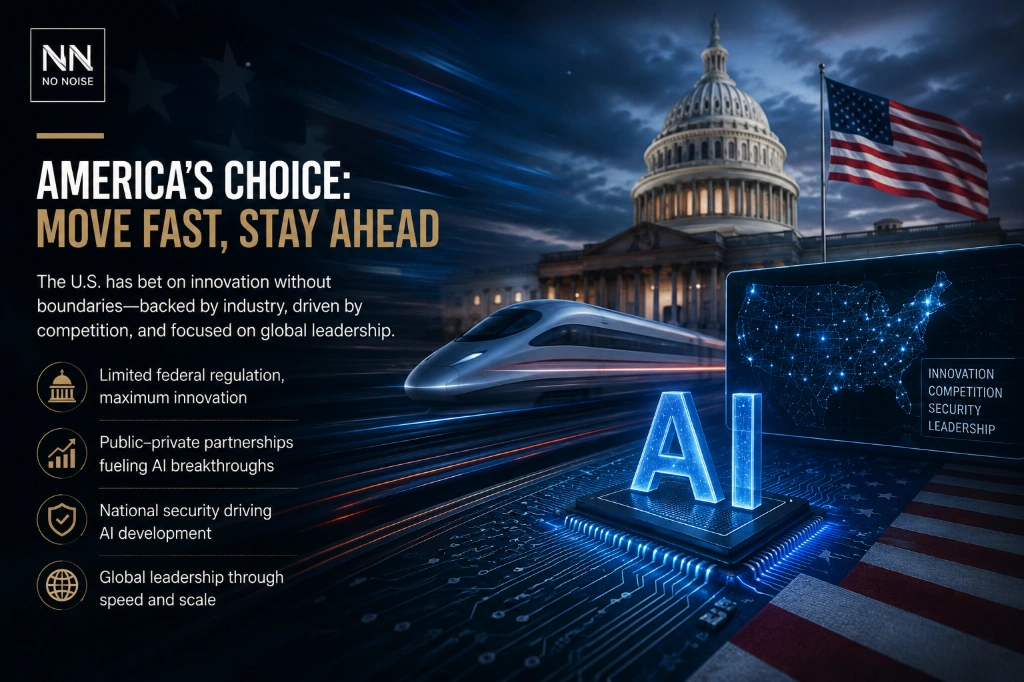
The United States has chosen a very different path.
Instead of implementing a single national AI law, Washington has relied on a combination of executive actions, agency oversight, industry commitments, and market-driven innovation.
The Biden administration attempted to establish guardrails through Executive Order 14110 on the safe and trustworthy development of AI. Meanwhile, the National Institute of Standards and Technology developed its AI Risk Management Framework, and the US AI Safety Institute was established to evaluate frontier AI systems.
At the same time, companies such as OpenAI, Anthropic, Google, Meta, and Microsoft continued to drive global AI development at unprecedented speed.
The American model reflects a belief that excessive regulation could undermine technological leadership.
That philosophy became even more pronounced following political shifts in Washington, with policymakers increasingly emphasizing competitiveness, infrastructure expansion, and AI leadership over precautionary regulation.
The United States therefore occupies a unique position: it remains the world’s most influential center of AI innovation while continuing to debate how much governance is necessary.
The tension between technological dominance and regulatory restraint is likely to remain a defining feature of American AI policy for years to come.
China’s State-Controlled AI Model
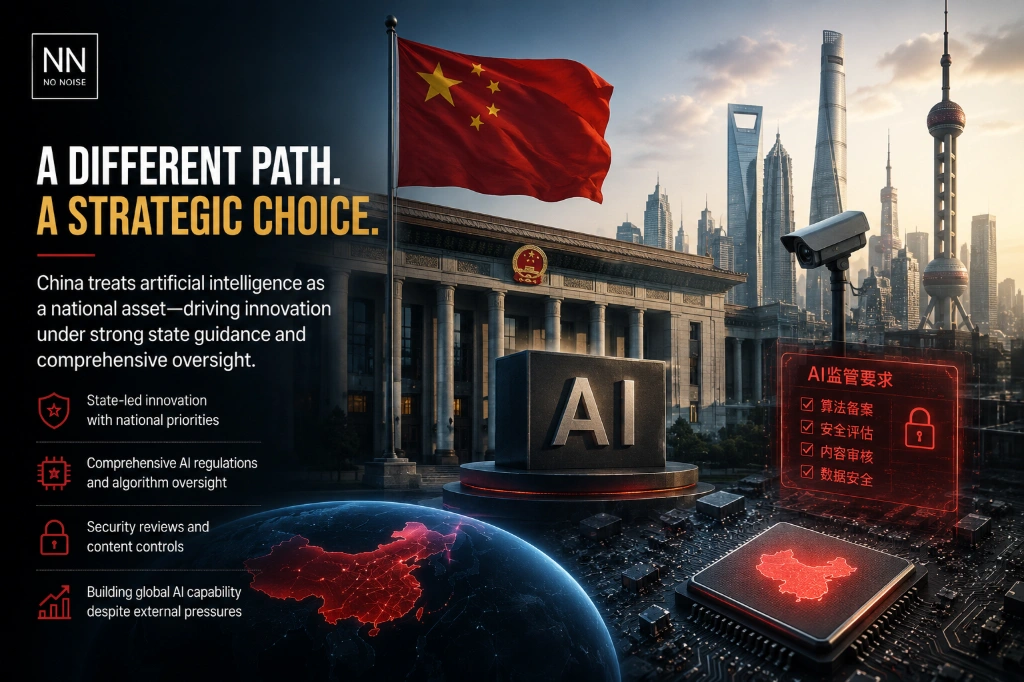
If Europe represents regulation-first governance and the United States favors market-led innovation, China has developed a third model—one that combines aggressive technological advancement with extensive state oversight.
China's approach treats artificial intelligence not merely as a commercial opportunity but as a strategic national asset.
Over the past several years, Beijing has introduced multiple AI-specific regulations, including rules governing recommendation algorithms, deep synthesis technologies, and generative AI services. Public-facing AI systems are required to comply with content controls, security reviews, and algorithm registration requirements administered by the Cyberspace Administration of China.
By late 2025, hundreds of generative AI services from companies such as Baidu, Alibaba, Tencent, and ByteDance had completed official filing and security assessment procedures.
At first glance, this model appears contradictory. China seeks to become a global AI leader while simultaneously imposing significant regulatory controls on AI deployment.
Yet Chinese policymakers view governance and innovation as complementary rather than competing objectives. The goal is not to slow AI development but to ensure it advances within clearly defined political and social boundaries.
This strategy has enabled China to pursue rapid deployment while maintaining substantial government influence over how AI systems operate.
However, China also faces external pressures.
American export restrictions targeting advanced semiconductors and AI hardware have become a critical obstacle. Restrictions affecting NVIDIA's most advanced AI chips and limits on semiconductor equipment exports have transformed the AI race into a broader contest over technological infrastructure.
Increasingly, AI governance is becoming inseparable from the global semiconductor competition.
India’s Search for a Middle Path
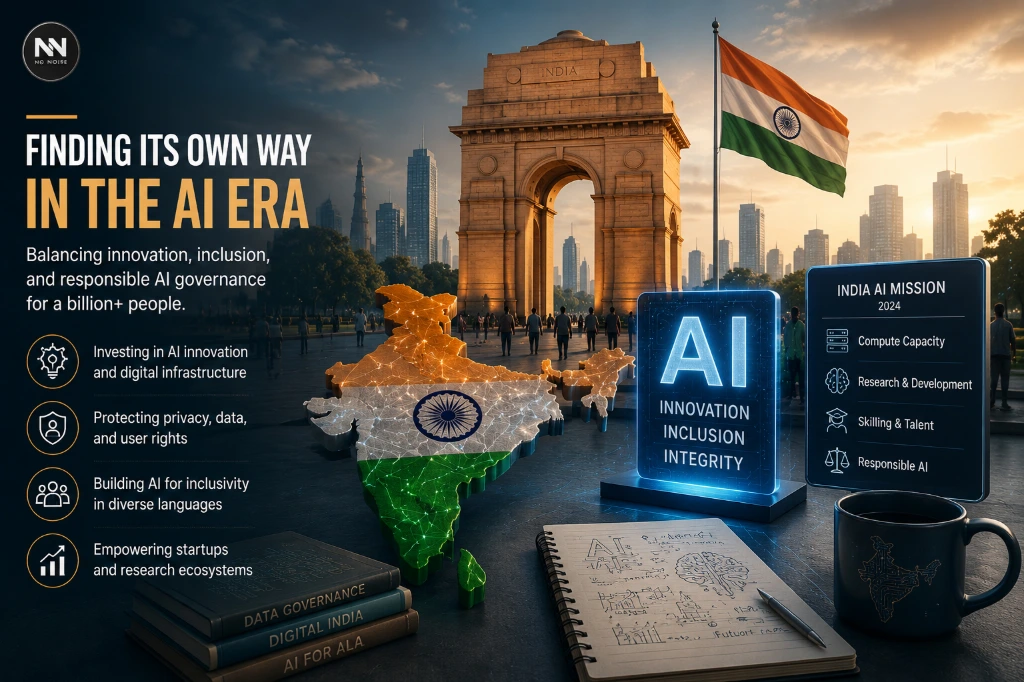
India occupies a unique position in the global AI landscape.
As one of the world's largest digital economies, India has enormous incentives to encourage AI innovation. At the same time, policymakers must confront concerns surrounding misinformation, algorithmic bias, privacy, language diversity, and digital inclusion.
Rather than introducing a single comprehensive AI law, India has adopted a more gradual and flexible approach.
The government approved the IndiaAI Mission in 2024 with funding exceeding ₹10,000 crore, aimed at strengthening domestic AI infrastructure, computing capacity, research ecosystems, and startup development.
Meanwhile, the Digital Personal Data Protection Act has begun shaping broader conversations around data governance and privacy.
India's challenge differs significantly from that of Europe, China, or the United States.
The country must build AI systems capable of serving a population spread across dozens of major languages, vast economic disparities, and dramatically different levels of digital access.
This creates opportunities as well as complications.
India increasingly presents itself as a democratic alternative within the emerging AI order—neither fully aligned with the American market-first approach nor the Chinese state-centered model.
Whether this balancing act evolves into a coherent long-term strategy remains one of the most important questions in global technology policy.
Why Global Coordination Remains Elusive

Although international organizations have repeatedly called for common standards, meaningful global coordination remains limited.
Several major initiatives have attempted to establish shared principles.
The United Kingdom's AI Safety Summit at Bletchley Park brought together governments from around the world. The G7 launched the Hiroshima AI Process. The United Nations adopted its first global resolution focused on artificial intelligence. Additional discussions followed in Seoul and Paris.
Yet none of these efforts produced a binding international framework comparable to those governing trade, aviation, or nuclear technology.
The reason is simple.
Countries increasingly view artificial intelligence as a source of economic power, military advantage, and geopolitical influence.
Under those conditions, regulatory cooperation becomes far more difficult.
Governments publicly support safer AI systems, yet few are willing to surrender strategic advantage. The closer AI becomes to economic and military power, the harder meaningful cooperation becomes.
The Semiconductor War Behind the AI Race
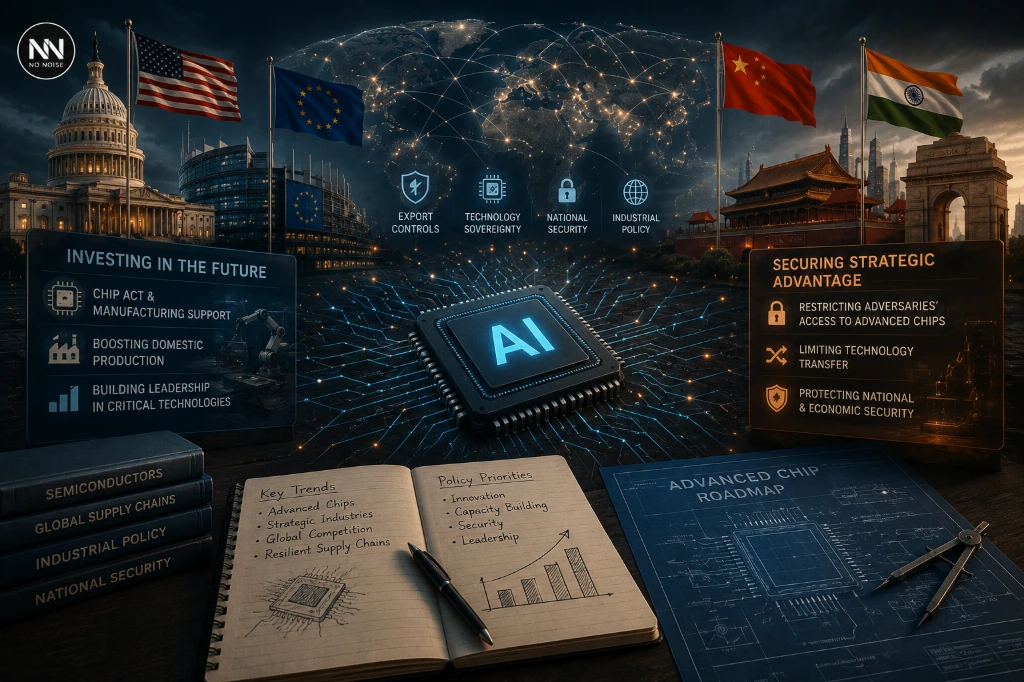
While public attention often focuses on chatbots and consumer applications, the most consequential AI battle may be occurring far below the software layer.
Advanced artificial intelligence depends on advanced chips.
This reality has transformed semiconductor manufacturing into one of the most strategically important industries in the world.
The United States has invested heavily through the CHIPS Act, supporting domestic production and encouraging companies such as TSMC to expand manufacturing capacity on American soil.
At the same time, Washington has imposed increasingly strict export controls designed to limit China's access to cutting-edge AI hardware.
Meanwhile, the Netherlands has restricted exports of some of ASML's most advanced lithography systems, technology widely viewed as essential to producing the world's most sophisticated chips.
For China, reducing dependence on foreign semiconductor technology has become a national priority.
For the United States and its allies, maintaining technological leadership has become a strategic objective.
AI governance, industrial policy, and national security are now converging into a single strategic arena.
What This Means for Technology Companies

The fragmentation of AI governance is creating new challenges for businesses operating across borders.
A system deployed in Europe may require extensive transparency documentation and risk assessments.
The same product in the United States may face different legal expectations.
In China, additional content restrictions, security reviews, and compliance requirements may apply.
As a result, governance is becoming a core part of product development.
Technology companies are increasingly building policy teams, legal departments, compliance frameworks, and safety organizations alongside engineering groups.
This shift favors large corporations.
Companies such as Microsoft, Google, OpenAI, Meta, and Amazon possess the resources required to navigate complex regulatory environments.
Smaller startups often do not.
Paradoxically, stricter regulation can sometimes strengthen dominant firms by increasing the cost of market participation.
The future AI economy may therefore be shaped not only by technical breakthroughs but also by the ability to navigate an increasingly fragmented regulatory landscape.
The Global South Risks Being Left Behind

For developing economies, AI governance is not merely a regulatory issue.
It is a question of technological sovereignty.
Many countries across Africa, Latin America, and parts of Asia rely heavily on AI systems developed elsewhere.
Those systems often reflect the assumptions, priorities, and datasets of the countries that created them.
This raises concerns about dependency, representation, and digital inequality.
The challenge extends beyond regulation.
Training advanced AI systems requires enormous investments in computing infrastructure, energy capacity, semiconductor access, and specialized talent.
Most countries lack the resources required to compete directly at the frontier.
This reality has fueled discussions around "digital colonialism"—the idea that emerging technologies could deepen existing global power imbalances if developing nations remain consumers rather than creators of AI systems.
As artificial intelligence becomes increasingly important to economic growth, the gap between AI producers and AI consumers may become one of the defining development challenges of the twenty-first century.
The Future May Be Defined by Competing Rulebooks

A single global AI framework appears increasingly unlikely.
Instead, the world seems to be moving toward a system of competing regulatory models.
Europe prioritizes trust and accountability.
The United States prioritizes innovation and market leadership.
China prioritizes strategic control and national objectives.
India seeks a flexible path that balances growth and governance.
None of these approaches is likely to disappear.
Rather than converging, they may continue evolving in parallel.
The most important consequence is that AI governance is no longer a technical debate reserved for regulators and engineers.
It has become a geopolitical issue.
The future of artificial intelligence may ultimately depend less on which company builds the most powerful model and more on which regulatory vision gains the greatest global influence.
The race to build artificial intelligence may define the next technological era. The race to govern it could determine who shapes the global order that follows.