
As Russian President Vladimir Putin arrived in Beijing for high-level talks with Chinese President Xi Jinping, the visuals looked familiar: handshakes, smiles, ceremonial diplomacy, and repeated references to “old friendship.”
But beneath the carefully managed optics, this visit carried a much deeper geopolitical message.
Just days after renewed global attention around Donald Trump’s diplomatic positioning and America’s unpredictable foreign policy debates, China appeared eager to project something very different — stability, continuity, and strategic patience.
According to Reuters, Beijing used Putin’s visit to reinforce its image as a calm and dependable global power at a time when international alliances are increasingly shifting.
And that may be the real story here.
China Wants To Look Like The Adult In The Room
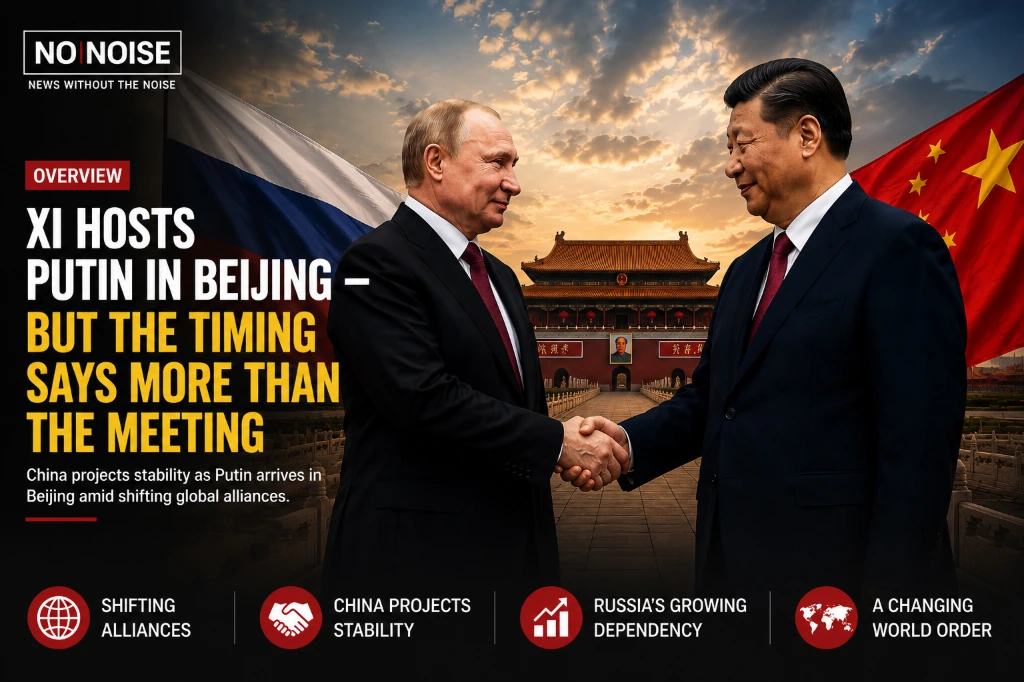
For years, the China-Russia relationship has been described as a partnership against Western dominance. But in 2026, the balance inside that partnership appears to be changing.
Russia still possesses military influence, nuclear power, and global relevance. But economically and diplomatically, China now looks significantly stronger.
Bloomberg noted that while Putin arrived in Beijing as a strategic ally, China increasingly holds the leverage in the relationship. Since the Ukraine war and Western sanctions isolated Moscow from much of Europe, Russia has become more dependent on Chinese trade, technology access, and energy partnerships.
That dependency changes the optics.
A few years ago, Xi and Putin were often presented as two parallel power centers challenging the West together. Now, many analysts see China as the steadier giant — while Russia struggles under economic and geopolitical pressure.
The meeting may have looked equal on camera.
But global observers are increasingly asking whether this is still a balanced alliance.
The “Neutral Superpower” Strategy
One of the most interesting aspects of China’s diplomacy right now is that Beijing does not want to appear openly confrontational all the time.
Instead, China is carefully building the image of a country that talks to everyone.
That theme was highlighted strongly by Al Jazeera, which described China’s broader attempt to position itself as a “neutral superpower” capable of balancing relationships across competing blocs.
Beijing continues trading heavily with the West while simultaneously deepening ties with Russia, expanding BRICS influence, and strengthening its role in the Global South.
This balancing act is strategic.
China understands that openly becoming “Russia’s sidekick” would damage its global ambitions. At the same time, abandoning Moscow would weaken an important counterweight against American influence.
So Beijing walks a carefully designed middle path:
- Support Russia economically
- Avoid direct military entanglement
- Present itself publicly as a stabilizing diplomatic force
That strategy helps China maintain flexibility while slowly expanding its global influence.
Why Trump’s Shadow Still Matters
Even though Donald Trump was not part of the Beijing meeting, his influence still hovered over the conversation.
Recent debates around Trump’s foreign policy direction, NATO commitments, and America’s global posture have created uncertainty among allies and rivals alike.
China notices that uncertainty.
According to The Hindu, the timing of Putin’s visit became especially significant because it happened amid growing global speculation about how future American leadership could reshape international alliances.
For Beijing, moments like this create opportunity.
If Washington appears unpredictable, China can market itself as the more stable long-term power.
That does not mean countries suddenly trust China more than the United States.
But it does mean Beijing is becoming increasingly effective at presenting itself as calm, disciplined, and strategically patient while other powers appear distracted by internal political battles.
The Symbolism Was Deliberate
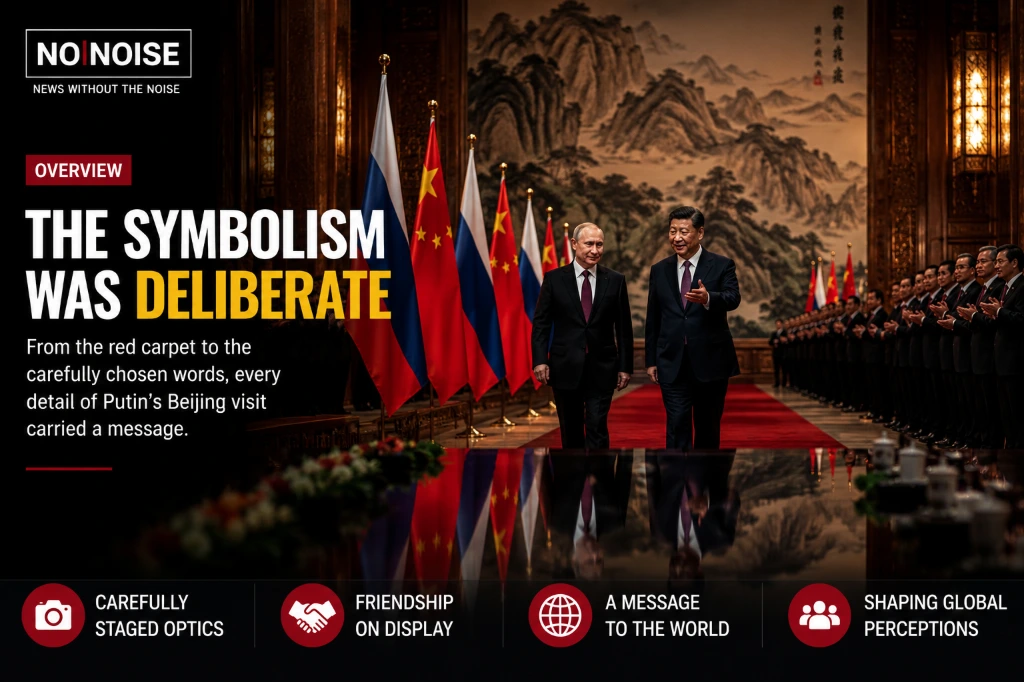
Diplomatic meetings are never just meetings.
Every camera angle, phrase, handshake, and public statement is designed to send a message.
Calling Putin an “old friend” was not accidental.
The images from Beijing projected familiarity, continuity, and resistance against Western pressure. China wanted global audiences to see that its relationship with Russia remains intact despite sanctions, criticism, and international tensions.
At the same time, Beijing also avoided excessively aggressive rhetoric.
That balance matters.
China wants to appear powerful — but not reckless.
Influential — but not isolated.
Strategic — but not emotional.
And in many ways, this visit reflected exactly that approach.
What The World Is Watching Next
The bigger question is not whether Xi and Putin remain partners.
They clearly do.
The real question is whether China is quietly becoming the dominant force inside that partnership — and whether the rest of the world is prepared for a future where Beijing increasingly acts as the central power broker across multiple global conflicts.
For now, the Beijing meeting delivered a carefully crafted image:
Russia still matters.
China looks stronger.
And the global balance of power continues to shift — slowly, visibly, and in real time.